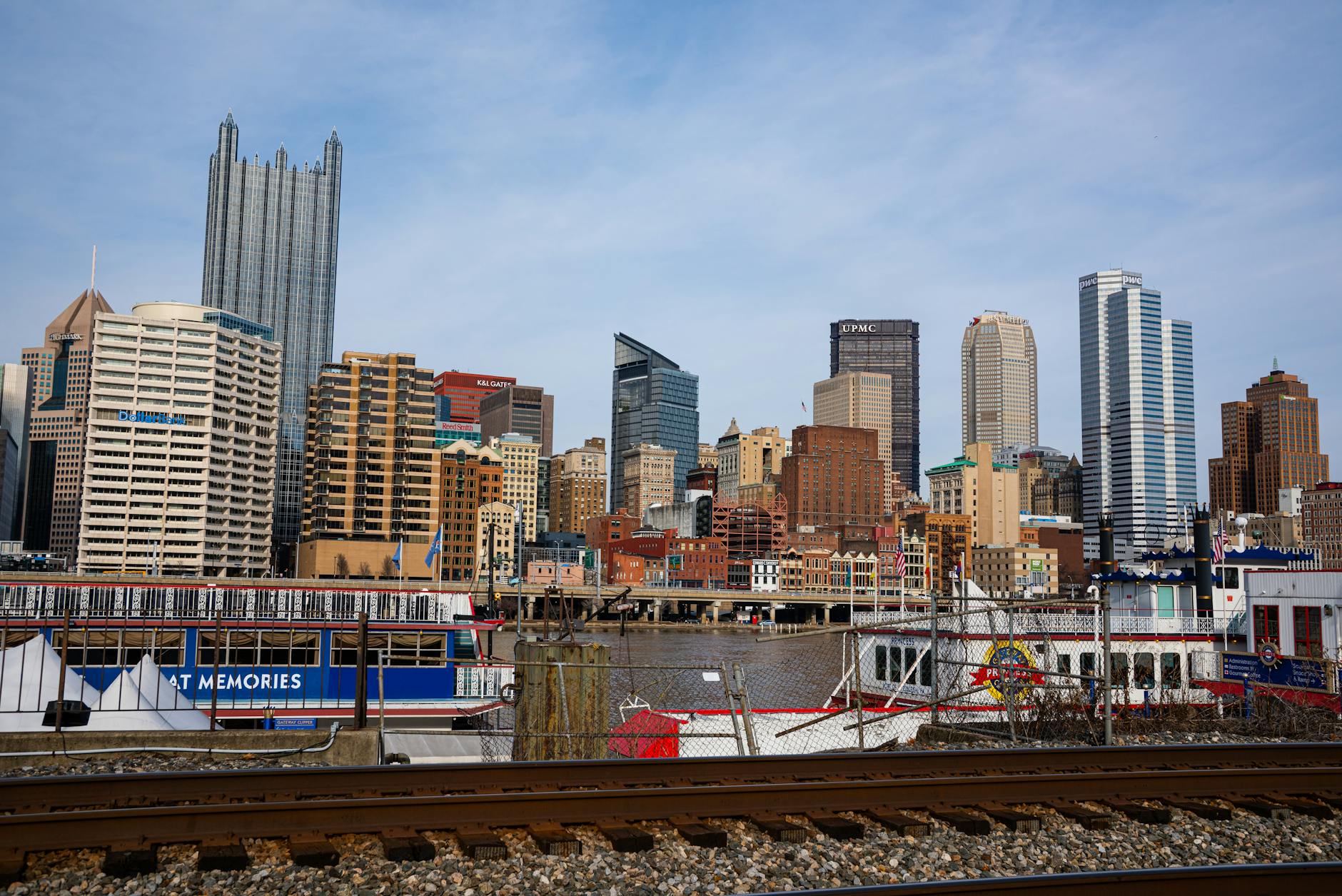

The best places to visit in Pittsburgh tend to surprise first-timers. The city isn't flat, it isn't simple, and it doesn't reveal itself from a single angle. It sits at the meeting point of three rivers, ringed by hills steep enough to make a grid street plan impossible, and packed with neighborhoods that each feel like a separate small city. A good visit here rewards curiosity more than a checklist.
Point State Park and the confluence
Start at the water. Point State Park sits at the western tip of downtown, where the Allegheny and Monongahela rivers meet to form the Ohio. The 36-foot fountain at the tip is the most photographed spot in the city, and for good reason: the view back toward downtown from the fountain's edge shows the skyline in full, framed by water on three sides. It's free, it's open year-round, and it takes about 20 minutes to walk the perimeter. Budget more time if you want to read the historical markers, which cover 300 years of fortification, settlement, and industrial transformation.
The Carnegie museums in Oakland
Oakland is Pittsburgh's academic and cultural core, and the Carnegie complex on Forbes Avenue anchors it. The Carnegie Museum of Natural History and the Carnegie Museum of Art share a single building and a single admission ticket. The natural history collection is genuinely world-class: the dinosaur halls hold original Diplodocus and Apatosaurus specimens that the institution excavated itself in the early 1900s. The art museum runs from Impressionist paintings to contemporary installations, with a permanent collection that includes works by Winslow Homer, Mary Cassatt, and Andy Warhol. Plan a minimum of two hours. Four is more honest if you intend to do both sides justice.
The best museums in Pittsburgh extend well beyond this single block. The Carnegie Science Center on the North Shore adds hands-on exhibits and a working submarine. The Senator John Heinz History Center in the Strip District covers Pittsburgh's industrial and cultural past in depth, with a full Smithsonian-affiliated collection.
The Duquesne Incline and Mount Washington
Pittsburgh has two working inclines, funicular railways that climb the steep face of Mount Washington from the South Side. The Duquesne Incline is the older and more visited of the two, dating to 1877. The ride takes about 90 seconds. The view from the top is the one that ends up on every postcard: the full downtown skyline, both rivers, and the bridges connecting them. Go at dusk if you can. The light hits the water in a way that's hard to overstate, and the observation deck stays open late. Grandview Avenue runs along the ridge and connects several overlook points, all walkable from the top station.
Frick Park and the East End ravines
Pittsburgh's terrain hides a wild interior that most visitors never reach. Frick Park covers 644 acres in the city's East End, with forested ravines, a functioning clay tennis court, and miles of trails that feel nothing like an urban park. The main entrance sits near the intersection of Forbes Avenue and South Dallas Avenue in Point Breeze, but the park has a dozen access points across Squirrel Hill, Regent Square, and Swisshelm Park. The Nine Mile Run trail corridor runs through the park's lower section, following a restored stream to the Monongahela. Wear shoes you don't mind muddying.
The Strip District on a Saturday morning
The Strip District runs along Penn Avenue between downtown and Lawrenceville, and Saturday morning is when it operates at full intensity. Vendors set up on the sidewalk by 7 a.m. Grocers, fishmongers, spice shops, and bakeries pack a stretch of about eight blocks. Staple stores include Wholey's Fish Market (open since 1912), Pennsylvania Macaroni Company (an Italian grocery institution), and the original Primanti Brothers, which serves its signature stacked sandwiches around the clock. The Strip is also the fastest-growing tech corridor in the city now, with new development pressing in on both sides, but the Saturday market culture has held.
Schenley Park and Phipps Conservatory
Schenley Park sits at the edge of Oakland, covering 456 acres that include a public golf course, a skating rink, a boathouse on Panther Hollow Lake, and dozens of miles of trails. It's Pittsburgh's most used park and still manages to feel uncrowded once you get past the main road. Phipps Conservatory and Botanical Gardens sits at the park's edge on Schenley Drive. The Victorian-era glass house holds a dozen distinct rooms of plants, from a tropical forest to a cactus room, and runs rotating seasonal exhibitions that draw serious crowds. Admission costs about $20 for adults in 2026.
Lawrenceville and Butler Street
Lawrenceville has become Pittsburgh's most concentrated dining and arts neighborhood, and Butler Street is the spine of it. The stretch from 34th to 52nd Street packs independent restaurants, bars, galleries, and boutiques into a walkable corridor that rewards a slow afternoon. Pittsburgh's public mural density is highest here, with dozens of works by local and visiting artists covering the walls between storefronts. The neighborhood is also home to some of the city's best new restaurants, several of which have earned national attention in recent years.
The view from the bridges
Pittsburgh has 446 bridges. Many of them are worth walking across, not just driving over. The Roberto Clemente Bridge (Sixth Street Bridge) connects downtown to the North Shore and offers an unobstructed river view in both directions. It closes to vehicle traffic on Pirates and Steelers game days, turning it into a pedestrian promenade. The Andy Warhol Bridge (Seventh Street) crosses the Allegheny slightly upriver and is decorated with yarn bombing and public art installations. Neither walk takes more than 10 minutes, and both sit within easy distance of each other.
Andy Warhol Museum
The Andy Warhol Museum sits on the North Shore, just across the Allegheny from downtown. It's the largest museum in the United States dedicated to a single artist, covering seven floors of Warhol's work, archives, and the cultural context that produced him. Pittsburgh is where Warhol grew up, and the museum treats that origin story with care. The permanent collection includes the silver cloud room, the Mao paintings, and a substantial archive of film and video work. The building itself is a converted warehouse with good natural light and a ground-floor café.
What connects all of it
Pittsburgh is a city best experienced by neighborhood, not by landmark. The places listed here are starting points. Each one sits within walking distance or a short bus ride of a full day's worth of additional discovery. The food scene alone can fill a visit: Shadyside for serious Italian and modern American, Squirrel Hill for one of the most walkable main-street dining corridors in the city, and the Strip District for everything from $4 pierogies to a bowl of pho that would hold its own in any American city.
The city's terrain does the editorial work for you. Turn a corner and you're looking down a valley at a neighborhood you didn't know existed. Walk up a stairway and you're on a ridge with a view that costs nothing. Pittsburgh earns repeat visits because it keeps producing new angles.