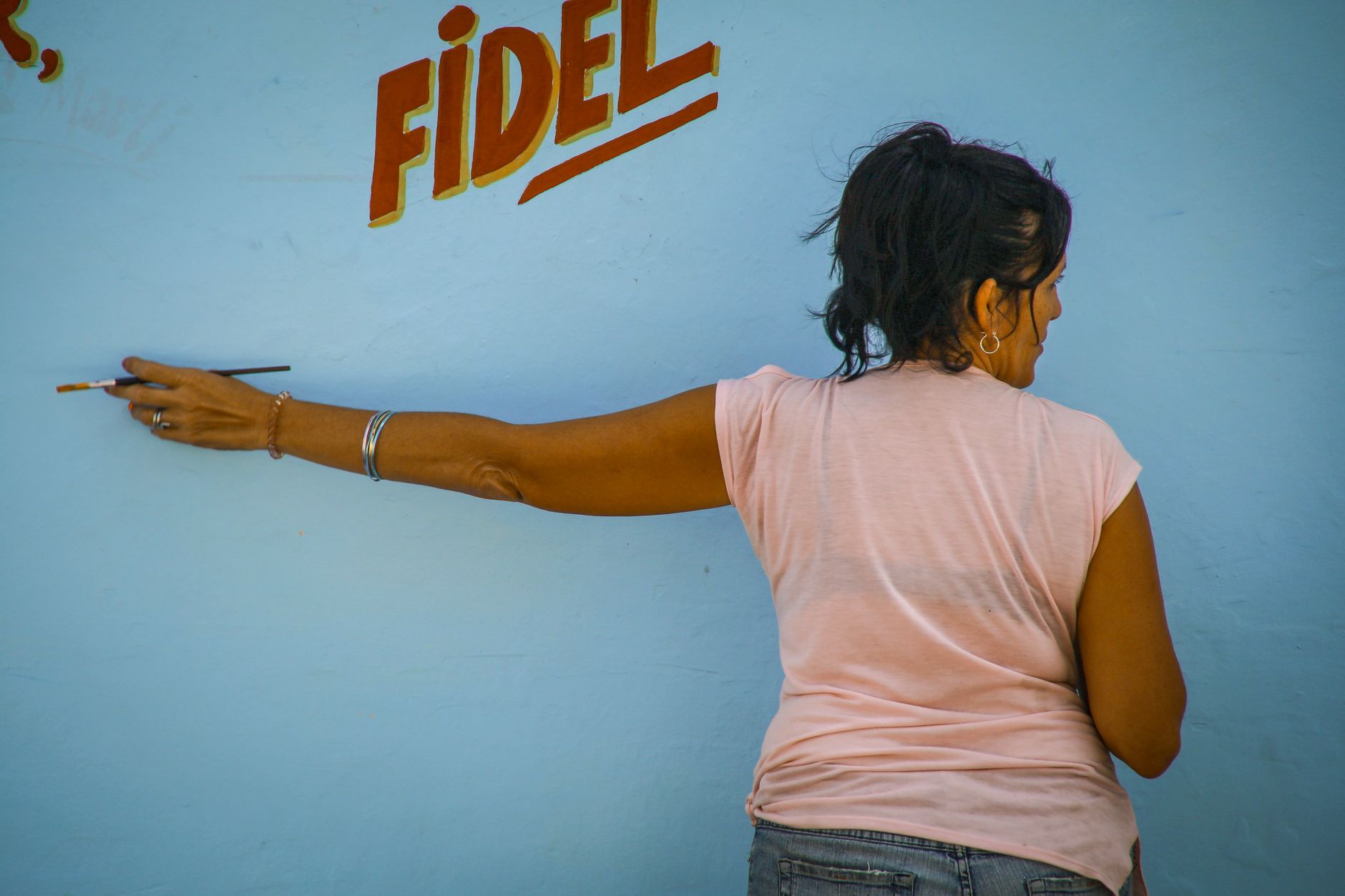

Hand lettering is one of those crafts that most people absorb without noticing. A well-painted sign on a bakery window, a mural that anchors a corner building, a menu board that feels too good to be a printout. In Pittsburgh, the people doing this work form a small and serious community, and their output touches almost every neighborhood in the city.
What hand lettering actually is
Hand lettering isn't calligraphy, and it isn't typography. It's the practice of drawing letters as illustrations, each one composed rather than written. A lettering artist plans the weight, spacing, and style of every character the way a graphic designer would plan a layout, then executes it with brushes, paint, gilding leaf, or chalk. The result is technically unrepeatable. Two signs painted from the same sketch won't be identical.
Pittsburgh's industrial past gave this craft unusual staying power here. Decades of painted business signage on brick walls left a visible record of the trade, and enough practitioners survived the desktop publishing era to pass their techniques forward. Today the city has a working lineage of lettering artists who trained under older sign painters and now take on everything from 40-foot exterior murals to hand-gilded pub windows.
Where the work shows up
Lawrenceville carries the densest concentration of hand-lettered storefronts in the city. Butler Street alone has more painted window signage than most American commercial corridors its size. Shadyside and the Strip District follow closely. Look at the older taverns near Penn Avenue and you'll spot the remains of gold-leaf lettering on glass that dates back 50 or 60 years, faded but still legible.
Murals are the other main venue. Pittsburgh has added hundreds of public murals since 2015, and a growing share of them incorporate lettering as a structural element rather than an afterthought. The Hill District in particular has become a canvas for text-forward work. Artists working there frequently pull from the neighborhood's history, using letterforms that reference mid-century signage and printing traditions. The storytelling dimension of that neighborhood makes text feel essential rather than decorative, something the article on Hill District Pittsburgh explores in depth.
The artists doing the work right now
Jess Rotter isn't Pittsburgh-based, but her influence has reached here through collaborations and workshops that brought West Coast brush-lettering sensibilities into contact with local artists. The more permanent Pittsburgh presence is people like sign painter and muralist Craig Colorusso, who runs commissions out of a studio on the North Side and has painted storefronts from Bloomfield to Beechview. Colorusso trained under a traditional sign painter in his 20s and absorbed techniques that were already considered endangered then.
Younger practitioners have come up through Pittsburgh's art schools. Carnegie Mellon's design programs and the Art Institute alumni have fed the city a steady stream of people who understand letterform at a technical level. Some of them move into branding and digital work. Others find their way back to paint and walls. The ones who stay in the physical medium often describe the decision in similar terms: they wanted work they could see from across the street.
The creative ecosystem that supports them extends into gallery spaces. Pittsburgh's art galleries regularly feature lettering-based work as fine art, not just applied craft, a shift that's made it easier for these artists to sustain a practice that mixes commercial commissions with exhibition work. If you're looking for where this gallery scene operates, Pittsburgh art galleries worth adding to your list covers the key venues.
The tools and the training gap
Traditional sign painting uses one-shot enamel, lettering enamels, and specifically weighted brushes called pencil quills and sword strippers. Gold leaf application requires a separate skill set: the surface gets sized with adhesive, the leaf is laid and burnished, and then the whole thing is clear-coated. Getting any of this wrong is immediately visible. There's no Ctrl-Z on a painted wall.
Finding instruction is harder than it should be. Formal apprenticeships in sign painting have been rare since the 1980s. Most working lettering artists in Pittsburgh learned through workshops, YouTube channels, and obsessive practice on cheap surfaces. The Society of Gilders and the Letterheads (a national sign-painting organization) both have Pittsburgh-area members who share knowledge at meetups, but there's no dedicated school program in the city that covers the trade end-to-end.
That gap hasn't stopped demand from growing. Businesses that tried vinyl lettering in the 2000s have been quietly switching back to painted signs, partly because hand-lettered signage photographs better in an era when storefronts live on social media, and partly because the durability of painted enamel on glass outlasts vinyl by decades.
What's keeping the craft alive
Three things have sustained hand lettering in Pittsburgh specifically. First, the city's brick building stock gives artists the right surface. Brick holds paint differently than steel or concrete, and Pittsburgh's streetscapes are dense with it. Second, the cost of commercial real estate here has stayed low enough that independent businesses can afford the custom signage that chains skip. A hand-lettered sign runs between $400 and several thousand dollars depending on size and complexity. That's a real line item for a small shop, but it's not out of reach.
Third, and less obvious: Pittsburgh's design community is tight enough that lettering artists actually know each other. They share clients, cover each other's commissions when a deadline conflicts, and collaborate on murals that would be too large for one person. That informal network functions as a mutual support system the way Caroline Gerdes describes her own creative practice: deeply local, built on relationships, and sustainable precisely because it's embedded in the city rather than oriented toward somewhere else.
The result is visible across Pittsburgh's neighborhoods right now, if you know what to look at. The next time a storefront catches your eye for reasons you can't quite name, look at the letters first.